
Reel Roads: Room 217 and the Hotel That Dreamed Up The Shining
Estes Park, Colorado — A Cinematic Pilgrimage to the Most Famous Haunted Hotel in American Literature
Picture this. A struggling writer and his wife check into an enormous, nearly empty mountain hotel on the last night of the season. The staff is already packing up. The dining room tables are already stacked with upside-down chairs, and pre-recorded orchestra music plays into a room with no one in it. The couple eats alone. Then they go upstairs to the only room that still has sheets on the bed.
That night, the writer has a nightmare so vivid and so specific that he wakes up drenched in sweat, lights a cigarette, stares out at the Rockies in the dark, and by the time the cigarette burns down to his fingers, he has the bones of one of the most celebrated horror novels ever written.
This is not a scene from a movie. This happened in Room 217 of the Stanley Hotel in Estes Park, Colorado, in late September of 1974. The writer was Stephen King. The nightmare was about his three-year-old son being chased through the hotel’s corridors by a fire hose that had come alive. The novel that grew from that single night was The Shining, published in 1977. And the hotel has never quite been the same since.
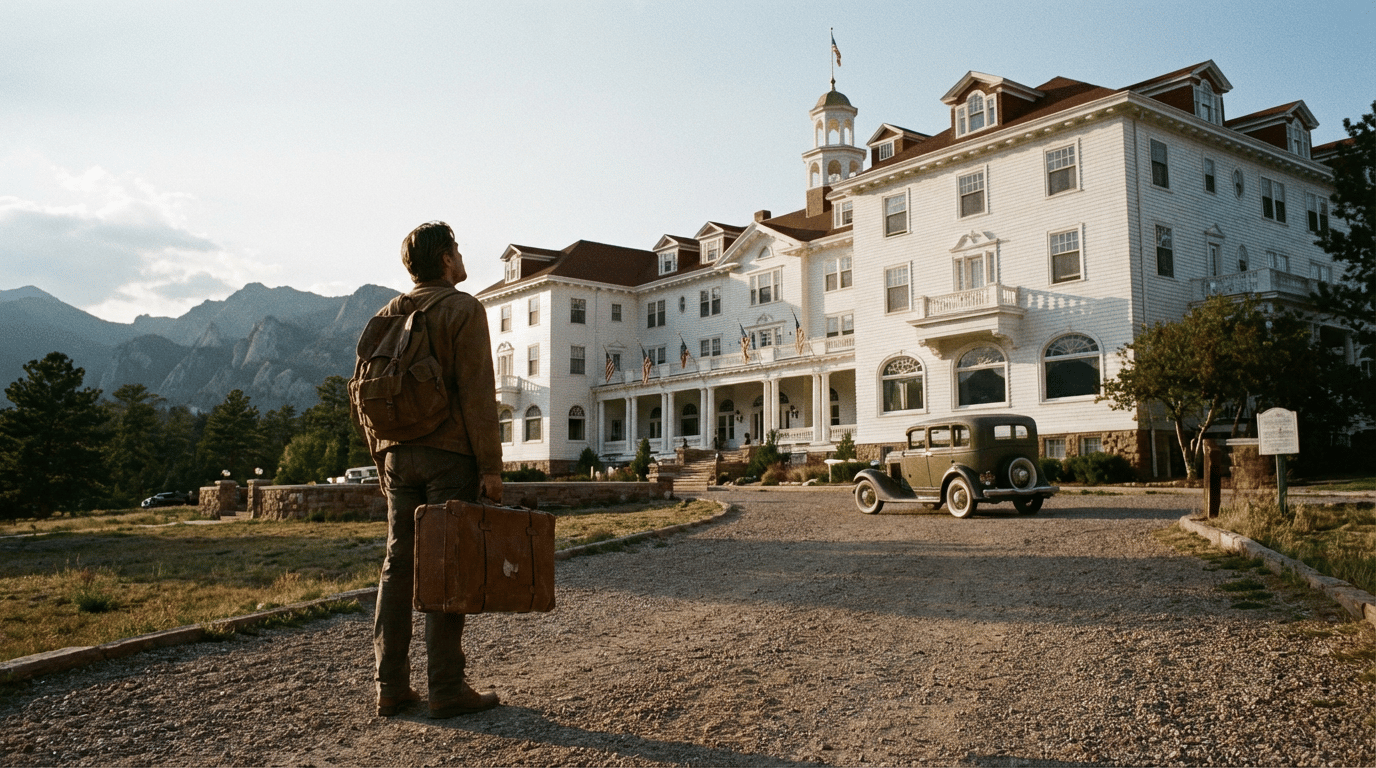
If you’re the kind of traveler who reads a book or watches a film and immediately wants to stand in the place where it happened, the Stanley Hotel is one of the great pilgrimages available to you. It is not a replica. It is not a theme park recreation. It is the actual building, still standing at 7,800 feet in the Colorado Rockies, still white against the mountain sky, still atmospheric in ways that are genuinely difficult to explain once you’ve stood inside it.
Two Films, One Hotel, and a Director Who Never Visited
Here is something every cinematic traveler should know before they book their room: Stanley Kubrick’s 1980 film adaptation of The Shining, arguably the most famous horror film ever made, was not filmed at the Stanley Hotel.
Kubrick’s Overlook used the Timberline Lodge on Mount Hood in Oregon for its exterior shots, and built his interiors almost entirely on soundstages at Elstree Studios in England, drawing design inspiration from the Ahwahnee Hotel in Yosemite. The iconic carpeted hallways, the hedge maze, the ballroom, the great lounge where Jack Torrance unravels — none of it was the Stanley. Kubrick even changed the pivotal room number from 217 to 237, reportedly at the request of the Timberline Lodge, whose management worried guests would be nervous about booking a room associated with supernatural horror. Room 237 does not exist at the Timberline. Room 217 does exist at the Stanley, and it is booked months in advance for every October on the calendar.
Stephen King, famously unhappy with how far Kubrick had strayed from his source material, took matters into his own hands in 1997. He wrote the screenplay for a three-part ABC miniseries himself, and insisted on one condition that Kubrick never agreed to: it would be filmed at the actual Stanley Hotel. The miniseries, directed by Mick Garris, is considered by many to be less artistically daring than Kubrick’s version, but it gave the Stanley something no other screen adaptation could: the real corridors, the real staircase, the real concert hall where Flora Stanley’s piano still sits. Props from the production remain in the hotel’s basement today, including the handbuilt dollhouse modeled after the building itself. Walking past it on the ghost tour is one of those small moments that catches you sideways.

So what you’re actually visiting at the Stanley is the place that started everything. Not the filming location of the famous movie, but the location that made the famous movie necessary. There is a meaningful difference.
What Staying Here Actually Feels Like
The Stanley is not a horror-themed hotel in the way that phrase might suggest. It doesn’t assault you with jump scares or plastic skeletons. What it does is something more interesting and harder to manufacture: it creates atmosphere through genuine history and genuine architecture.
The main building is a white Georgian Revival structure that opened on July 4, 1909. It was one of the first fully electrified hotels in the world, built by Freelan Oscar Stanley, the inventor of the Stanley Steamer automobile, who came to Estes Park dying of tuberculosis and was cured by the mountain air. The bones of the building are original. The woodwork, the grand staircase, the concert hall with its vaulted ceilings and the piano F.O. gave his wife Flora as an opening gift — all of it has been restored rather than replaced.
Walking the corridors at night, particularly after the day tour groups have gone, is an experience that earns the word atmospheric without needing anything supernatural to back it up. The hallways are long and quiet. The building makes sounds that old buildings make. The altitude — sitting at nearly 8,000 feet — affects people in subtle ways: a slight dizziness, a mild hypersensitivity, the kind of heightened state that makes everything feel slightly more charged than usual. Whether that’s altitude or something else is for you to decide.
Every room in the hotel has a channel dedicated to playing Kubrick’s The Shining on continuous loop. Falling asleep with it on is either a delightful choice or a decision you will immediately regret. Most guests report it was both.
The word “REDRUM” is still scrawled on an attic door. The hotel’s hedge maze, a nod to Kubrick’s film that actually doesn’t appear in King’s novel at all, was added to the front grounds in 2015 and is free to explore during daylight hours. King’s book featured topiary animals rather than a maze, so the hedge maze is technically a tribute to the adaptation King openly criticized. The hotel seems to enjoy this irony. It has developed a healthy sense of humor about its own mythology.
The Rooms Worth Knowing
Room 217, now officially called the Stephen King Suite, is the one most people come for. It is on the second floor, has a private balcony overlooking the front of the property, and is furnished in a style that reflects the hotel’s Edwardian origins. You cannot book it online. Call the hotel directly at (970) 577-4000 to check availability. Rates run roughly $329 to $399 per night before taxes, and October dates are often gone months in advance.
The fourth floor is where the hotel’s paranormal activity is most consistently reported. Rooms 401, 407, 418, and 428 are all considered “spirited rooms” and are bookable through the hotel’s website, priced at a premium. Room 401 features the famous locked closet that investigators from the Ghost Hunters television series documented opening on its own during a filmed stay. Room 407 is associated with Lord Dunraven, the controversial Anglo-Irish nobleman who owned the land before F.O. Stanley, and whose face has reportedly been seen in the window by guests. Room 418 is where children’s laughter has been heard in empty hallways for as long as anyone at the hotel can remember.
For a deeper look at the full paranormal history of the property and all the spirits said to inhabit it, our Ghost Trails companion post, The Stanley Hotel: Where the Nightmare Became the Novel, goes into the building’s haunted lore in considerable depth —including the 1911 gas explosion that created the most famous ghost in the building, Elizabeth Wilson, the housekeeper who still reportedly unpacks your luggage whether you asked her to or not.
The Tours: Which One Is Right for You
The Stanley runs several structured tour experiences, and for a cinematic traveler, these are worth planning around rather than treating as an afterthought.
The History and Shining Tour runs during the day and covers the filming locations used in the 1997 miniseries, the areas of the hotel that inspired King’s novel, significant rooms and spaces with documented connections to the story, and the basement displays that include miniseries props. This is the tour for people who want the literary and cinematic context without the lights-out paranormal focus. It runs roughly 90 minutes.
The Night Ghost Tour goes deeper into the building with the lights down, covering the tunnels beneath the hotel, the most documented paranormal locations, and the layered human history behind each reported spirit. For travelers who want both the cinematic history and the genuine ghost hunting experience, this is the better choice.
The Paranormal Investigation is a five-hour deep-dive with equipment and a lead investigator. This is for the committed, and it books out fast.
All tours require advance booking through the Stanley Hotel’s official website. Parking on the property runs $10 during peak season (May through October), and the hotel issues a token that converts to a $5 credit at their restaurants or bar. The tour walks cover approximately a mile and a quarter total, with some stairs, and the altitude genuinely affects some visitors — so hydrating before you arrive is practical advice, not a formality.
When to Go
Each season at the Stanley offers something genuinely different, and the right choice depends on what you’re after.
September and October are the peak cinematic and paranormal seasons. The aspens turn gold in the surrounding mountains, the elk rut brings enormous bulls into the streets of Estes Park at dawn and dusk, the crowds thin compared to summer, and the atmosphere of the hotel in autumn feels closest to what King experienced on that 1974 night. October books out faster than any other month. If Halloween weekend is your target, plan at least six months ahead. This is not an exaggeration.
Summer (June through August) is when the hotel and Rocky Mountain National Park are at their most accessible and most crowded. The scenery is extraordinary, wildflowers blanket the high country, and the hotel is fully alive with activity. Tour availability is excellent, and the town of Estes Park is fully operational. If you want the easiest, most convenient version of this trip, summer delivers. Just know that Room 217 and the fourth floor spirited rooms will require advance planning regardless of season.
Winter offers the most atmospheric experience and the lowest rates. The hotel no longer closes for the season as it did in King’s era, and a winter stay at the Stanley — with snow on the Rockies and the corridors quiet in ways they aren’t in warmer months — is as close as you can get to the environment King actually inhabited that September night. Some tours operate on reduced schedules, so confirming availability before booking is worthwhile. The roads can require winter tires or four-wheel drive depending on conditions.
Spring (April and May) is the overlooked sweet spot. Rates are lower, the crowds are smaller, wildlife is active as animals move back into lower elevations, and the hotel has a particular stillness to it that feels earned after a long Colorado winter.
Getting There: The Journey Is Part of the Story
The Stanley sits at 333 Wonderview Avenue in Estes Park, roughly 70 miles northwest of Denver. The drive typically takes between 90 minutes and two hours depending on traffic, though the hotel’s own website notes that Denver traffic can stretch it to three hours on busy weekends. Give yourself time.
The most direct route from Denver follows US-36 north through Boulder and Lyons before climbing into Estes Park. It’s a straightforward, well-maintained road with no serious mountain passes, and it offers the mountain views developing gradually as you head north, which makes the final arrival into the Estes Valley feel like an unveiling. This is the recommended route if you’re arriving for the first time or driving in winter conditions.
The scenic route is the Peak to Peak Scenic Byway, Colorado State Highway 72, running south to north through the mountain communities of Black Hawk, Nederland, Ward, and Allenspark before connecting to Estes Park. Driven from south to north, the views improve as you go, with the Front Range opening up on your left in ways that make the entire drive feel like it was staged. Add an hour to your travel time and stop at Brainard Lake if it’s open. You will not regret it.
The Big Thompson Canyon approach via US-34 from Loveland is the third option, a dramatic canyon drive that follows the Big Thompson River through narrow rock walls before opening into the Estes Valley. The canyon is spectacular and one of the most memorable road approaches to any mountain destination in Colorado. Many locals recommend combining routes — taking Peak to Peak up and Big Thompson Canyon back down — which covers the best of both and gives you a genuine sense of the landscape surrounding the hotel.
Without a car, the Estes Park Shuttle operates year-round with service from Denver and drops directly at the Stanley. Schedules vary seasonally, and the hotel’s concierge can assist with details. If you’re flying into Denver International Airport, car rentals are widely available, and the drive is genuinely part of the experience. Do not outsource it to a rideshare if you can help it. The road is part of the story.
Once in Estes Park, the town’s free seasonal shuttle system makes it easy to move between the hotel, downtown, and Rocky Mountain National Park without moving your car, which matters in summer when park road congestion can be significant.
Making the Most of Your Stay
Plan at least two nights. One is enough to see the hotel and take a tour. Two is enough to actually inhabit it — to eat dinner in the Cascades Restaurant in the evening quiet, to explore the grounds in the blue hour before sunrise when the elk sometimes drift across the hillside below the hotel, to sit in the Whiskey Bar and let the building settle around you.
If you’re a reader, bring the novel. Not as a prop — but as a companion. Reading King’s descriptions of the Overlook while sitting in the room that inspired them is one of those experiences that collapses the distance between imagination and place in a way that’s genuinely worth seeking out.
If you’re a film person, watch both versions before you go. Kubrick’s 1980 film is available on Max. The 1997 King miniseries is on Peacock. They are entirely different experiences and they are both better for knowing where the story actually began. Standing in the hotel corridor that served as the miniseries set, or sitting in the concert hall where the production filmed its ballroom scenes, lands differently when you’ve seen the footage.
And if you find yourself curious about what the hotel is like for the people who come specifically for the paranormal — rather than the cinematic history — our Ghost Trails companion post, The Stanley Hotel: Where the Nightmare Became the Novel, goes deep into the history of the hauntings, the documented phenomena, the specific rooms, and what ghost hunters actually experience when they spend a night here. The two experiences — cinematic pilgrimage and paranormal investigation — are not mutually exclusive. At the Stanley Hotel, they never have been.
Book rooms and tours directly through the Stanley Hotel’s official website. For Room 217, call (970) 577-4000. Spirited rooms and October dates book months in advance. Rocky Mountain National Park requires a timed entry reservation permit during peak summer season, available through Recreation.gov.