
Paws & Away: What Every Pet Traveler Needs to Know Before They Book That Ticket
There’s a moment every devoted pet parent knows — the one where you’re packing your bag and your dog is watching you with those eyes, the one that says please don’t leave me. For a lot of us, the answer stopped being “I have to” a long time ago. We just take them with us.
But traveling with a pet isn’t simply a matter of love and good intentions. It’s logistics, paperwork, timing, and a genuine understanding of the rules — rules that, if you don’t know them before you get to the airport, can unravel your entire trip in ways you won’t see coming.
Case in point: in early February 2026, a woman named Germirah Bryson arrived at the JetBlue counter inside Harry Reid International Airport in Las Vegas. She had her dog with her. What she didn’t have was her dog registered as a passenger — a step that has to be completed online, in advance, not at the counter. When a JetBlue agent explained this to her, she reportedly responded by tying the dog’s leash to a luggage measurement device and said, “Call animal control. I’m not going to miss my flight.” Walking toward security, she was arrested. The dog — who quickly came to be named “JetBlue” by the ever-present internet — was later adopted by one of the officers who responded to the scene.
It’s a story that’s easy to react to with disbelief. But tucked inside the chaos is a warning that applies to all of us: not knowing the rules is not the same as being exempt from them. The good news is they’re not complicated once you know where to look.
Flying with Your Pet: The Real Rules
Airlines separate pets into a few distinct categories, and the category your animal falls into determines everything — which forms you fill out, how much you pay, and where your pet actually sits on the plane.
Pets flying in the cabin are generally small animals, usually dogs or cats that fit in an approved soft-sided carrier under the seat in front of you. Most airlines cap this at around 20 pounds including the carrier, though policies vary. You’ll pay a one-way fee that typically runs between $95 and $150 depending on the airline. You have to reserve the spot in advance, because there’s a limit to how many pets are allowed in the cabin per flight — usually two to four. This is the detail most people miss. You can’t just show up with a carrier and assume that there is room available. It’s best to call or book online before you even think about packing. Every major airline has a dedicated pet travel portal on their website — here are direct links to the biggest carriers: Delta, United, American, Southwest, JetBlue, and Alaska Airlines. Use them early!
Top Pick for Cabin Travel
If you are navigating a busy TSA checkpoint with an anxious pet, a standard carrier won't cut it. We highly recommend the Sherpa Original Deluxe Travel Pet Carrier. It's airline approved and part of Sherpa's Guaranteed On Board program, so you can fly with confidence knowing your carrier meets requirements. $46.90 $73.50

Pets flying as cargo travel in the pressurized, temperature-controlled belly of the plane in an airline-approved hard crate. This is the option for larger dogs who can’t fly in the cabin. It costs more, requires more documentation, and is not offered by every airline on every route — especially during extreme heat or cold, which matters a great deal if you’re flying into or out of a desert city in summer or an extremely cold area. Some airlines have suspended live animal cargo programs entirely, so confirming this directly with your carrier before you book is non-negotiable.
One non-negotiable across the board: your pet needs to be current on vaccinations and you’ll need documentation. Most airlines ask for a health certificate from your vet issued within ten days of travel. Some destinations — especially international ones — require additional testing, microchipping, and waiting periods that can span months. If you’re planning a trip abroad with your pet, start researching at least six months out. Hawaii, the UK, Australia, and New Zealand have some of the strictest import rules in the world.
Service Animals, Emotional Support Animals, and the Gap Between Them
Service animals operate under a different framework entirely, and if you travel with one, or think you might, the rules have shifted significantly enough in the last few years that whatever you heard before 2021 may no longer apply.
Under the U.S. Department of Transportation’s revised rule, which took effect January 11, 2021, the only animals airlines are federally required to accommodate as service animals are dogs — specifically, dogs that are individually trained to perform a task or do work directly related to a person’s disability. That could be a guide dog, a seizure alert dog, a dog trained to interrupt self-harming behavior, or a dog that detects a diabetic emergency before the person can. What matters is the training — specific, documented, task-based training. Not the vest. Not the registration card you bought online for thirty dollars. The training.
Psychiatric service dogs — trained to assist someone with a diagnosed mental health condition — are treated the same as traditional service dogs under this rule. That’s an important protection. But here is where a lot of people get lost: emotional support animals are not the same thing as service animals, and they no longer receive the same federal protections.
An emotional support animal, or ESA, is an animal that provides comfort, companionship, or calm to someone dealing with emotional or psychological challenges. The bond is real. The relief is real. But under the current DOT rule, providing comfort does not legally qualify as a “task.” And that distinction changes everything.
Before 2021, passengers could fly with an ESA, often for free, with a letter from a licensed mental health professional. Airlines had to accept them. For a while, that letter was easy enough to obtain online, and the system became, to put it kindly, strained. There were peacocks at airport gates. A support squirrel. A full-size turkey. A pig on a cross-country flight. Airlines began reporting a 40 percent increase in cabin animals, along with a rising number of biting incidents and disruptions. The DOT received more than 15,000 public comments before issuing its revised rule; more than 3,000 of them specifically supported removing the ESA designation from service animal protections.
Today, every major U.S. carrier — Delta, United, American, Southwest, JetBlue, Alaska — treats ESAs as pets. That means standard pet fees apply, standard carrier requirements apply, and the same advance booking rules apply. If you were counting on your ESA letter to get your dog into the cabin for free, that letter will not help you at a JetBlue counter anymore. You’ll need to have registered your pet through the airline’s standard pet program, paid the fee, and confirmed the reservation before you ever left the house.
There is one narrow path that still offers broader accommodation: if your animal is a trained psychiatric service dog — one that can perform specific, demonstrable tasks. You can file the DOT’s required forms with your airline, typically 48 hours before departure. There are two federal forms you’ll need to know about:
The DOT Service Animal Air Transportation Form (updated September 2024) is the primary document needed. It attests to your animal’s training, health, vaccination status, and behavioral history. Every airline that requires documentation uses this form, though some airlines like Delta and American ask you to submit it through their own online portals. Check your specific carrier’s service animal page for their submission process.
If your flight is eight hours or longer, you’ll also need the DOT Service Animal Relief Attestation Form, which confirms the animal will not relieve itself in the cabin or can do so in a sanitary manner during a long flight, or that it can comfortably wait until landing. Both forms are fillable PDFs, and both should be submitted to the airline, not to the DOT itself.
None of this means emotional support animals don’t matter. For many people, they are profoundly meaningful companions. It just means the logistics have changed, and knowing that before you reach the check-in counter is the difference between a smooth departure and a very public, very stressful scene.
What Can Never Board a Plane
Even if you do everything right — register in advance, get the health certificate, and book the pet spot — there are animals that simply cannot fly commercially, regardless of how beloved they are. Some of these rules come from the DOT. Some are individual airline policies. Either way, they are firm.
Snakes and reptiles occupy complicated territory. Some airlines permit small, non-venomous reptiles in the cabin. Venomous snakes are universally prohibited, large constrictors are universally prohibited, and most major carriers have banned all snakes from the passenger cabin entirely. Delta and United prohibit them with no exceptions. If you keep a reptile as a pet and need to transport them, cargo is usually the only commercial option, and policies vary enough that calling the airline directly is the only way to get a reliable answer.
Rodents — hamsters, rats, mice, and squirrels — are banned from the cabin on most major U.S. carriers. A handful of airlines like Frontier allow small domestic rodents on certain domestic routes, but they’re outliers. The reasoning comes down to containment risk. A hamster in a carrier might seem harmless, but an escaped rodent in a pressurized cabin at 35,000 feet is a very different situation.
Ferrets are banned on all U.S. commercial flights, full stop. The DOT specifically lists them alongside snakes, reptiles, and spiders as animals that airlines are permitted to exclude entirely, and every major domestic carrier has done exactly that.
Spiders and insects — however much you love your tarantula — are banned across the board. No airline, no route, no exception.
Birds require a more careful explanation, because the rules are inconsistent. Small household birds — a canary, a parakeet, a small dove — are permitted in the cabin on some airlines for domestic flights. But large birds, birds of prey, parrots, macaws, and cockatoos are prohibited by most carriers. If you have a parrot who is your constant companion, you’ll want to research specialist pet transport services rather than assuming any commercial carrier will accommodate them.
Goats, pigs, and farm animals. Yes, all of this has been attempted — and are prohibited everywhere. The fact that this had to be written into official airline policy is, in its own way, a remarkable piece of American travel history.
Exotic and wild animals are where things get both complicated and genuinely important. If your pet is classified as an exotic species — certain primates, hedgehogs, sugar gliders, kinkajous, large lizards — there may be layers of regulation beyond any airline’s policy: USDA permits, CITES documentation for internationally protected species, or outright import and export bans depending on your destination. If you’ve adopted an unconventional pet and want to travel with them, the first call is not to the airline but to a licensed wildlife veterinarian or an international pet transport specialist.
The bottom line: the more unusual your animal, the earlier you need to start researching, and the more directly you need to verify policies with both the airline and any relevant federal agencies.
On the Train: A Gentler Option
If flying feels like too much for your animal — or for you — trains are genuinely worth considering, and for many pets, this is a far more humane experience. Amtrak’s pet program allows small dogs and cats (up to 20 pounds, carrier included) on most routes for a fee of around $29 each way. The train is limited to five to seven pets per train, so booking early matters. Trips have to be under seven hours under the current policy, which rules out coast-to-coast journeys but works beautifully for regional travel. Your pet stays in a carrier at your feet, you stay calm, and nobody ends up on the local news.
The train environment tends to be gentler on animals than planes. Less altitude change, less pressure, less noise from engines at close range. For a dog who gets anxious in the air, a train through the Hudson Valley or along the California coast might actually be a lovely experience for both of you.
Road Trips: The Most Forgiving Option If Done Right
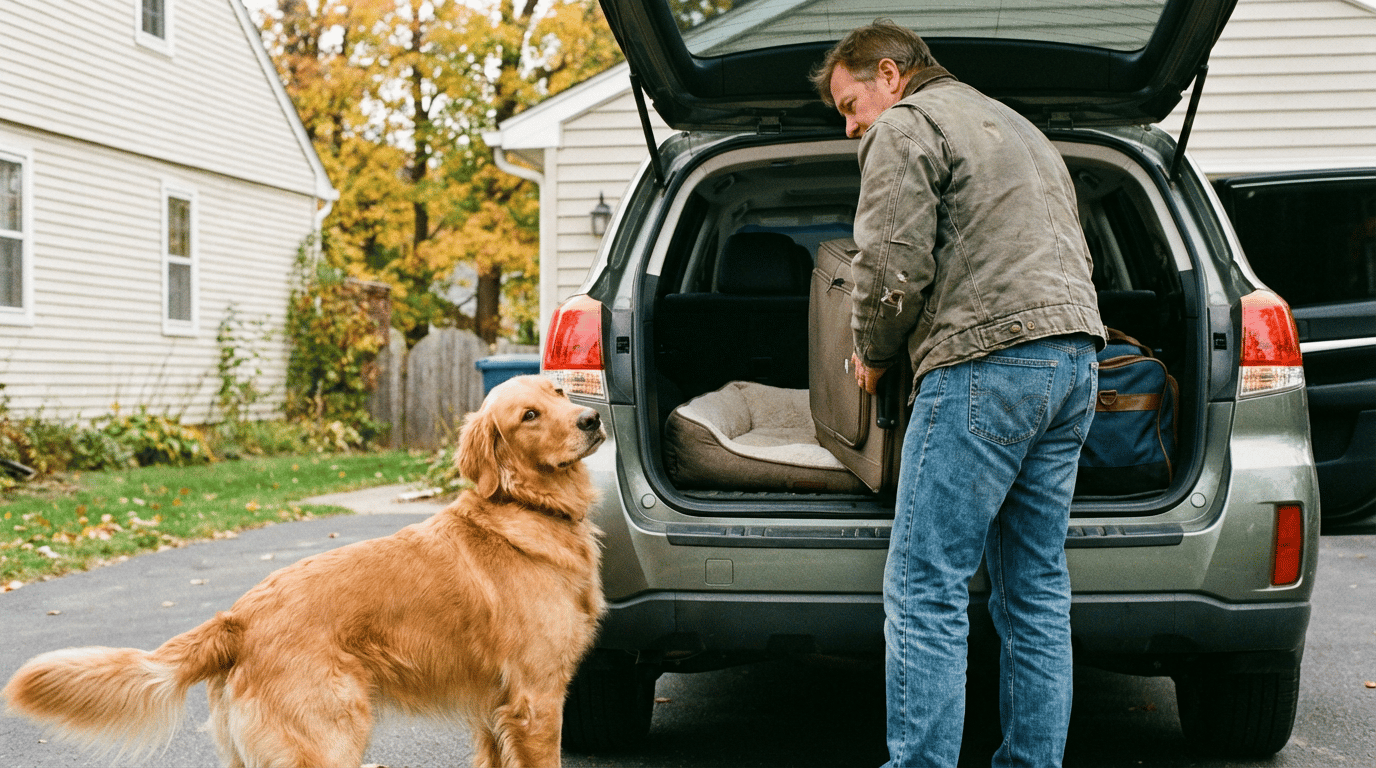
The car is where most pet travel happens, and it’s also where the most preventable mistakes happen. Here’s what actually makes a difference:
Essential Road Trip Gear
A pet roaming free in the backseat is a major safety hazard on a long road trip. You need a heavy-duty, crash-tested travel harness that clips directly into your car's seatbelt system. The Kurgo Tru-Fit Smart Harness is fully adjustable and rigorously tested to keep your dog secure during sudden stops.

Keep your pet secured. An unrestrained dog in a moving vehicle is a safety risk for everyone, not just the dog. Crash-tested harnesses, travel crates secured to the seat, and pet barriers all work. An unsecured 60-pound dog becomes a projectile in a sudden stop. That’s not dramatic; that’s physics.
Plan your stops. Every two hours is a good rhythm — gives a chance to stretch, drink water, and take a short walk. Dogs especially need this, both physically and emotionally. A pet who feels included in the journey, rather than just cargo in it, tends to travel much better.
Never leave your pet in a parked car. On a 75-degree day, the inside of a parked car can reach 115 degrees within an hour. In Las Vegas in July, it happens faster than that. Many states have laws allowing bystanders to break a car window to rescue an animal in heat distress. It is never worth the risk.
Talk to your vet before any long trip. Some animals genuinely don’t travel well, and there are safe, vet-approved options for anxiety— from calming supplements to prescription medications — that can make the journey kinder for your pet. Don’t try to figure this out at a rest stop in the middle of Nevada.
Before You Go: The Checklist That Actually Matters
Carry a copy of your pet’s vaccination records and health certificate every time you travel, even if you don’t think you’ll need them. Bring enough of your pet’s regular food for the entire trip plus a couple of extra days — switching food mid-travel invites stomach problems at the worst possible moment. Pack a familiar blanket or toy. The smell of home is grounding for an animal in an unfamiliar place.
If you’re flying with a service animal, download and complete the DOT Service Animal Air Transportation Form and submit it to your airline at least 48 hours before departure. For flights over eight hours, have the DOT Relief Attestation Form ready as well. If you’re flying with a pet under the standard program, go directly to your airline’s website and find their pet reservation portal.
And if you’re flying any airline, any route — complete every registration step before you leave your house. Calling from the airport counter is too late. The reservation is the protection. The reservation is what keeps your dog on the plane and you on the right side of a viral news story.
The woman in Las Vegas clearly loved her dog enough to bring him to the airport. Somewhere in the gap between love and preparation, things went terribly wrong — for her, and almost for him. He got lucky. He got a good home and a name that trended on the internet for a week.
Your pet deserves the same good outcome, just with a lot less drama getting there.
Policies for service animals, ESAs, and standard pet travel are subject to change. Always verify current requirements directly with your airline, Amtrak, and the DOT’s official service animal resource page before booking. Your veterinarian is your best first call for health certificates, travel anxiety, and any destination-specific requirements.